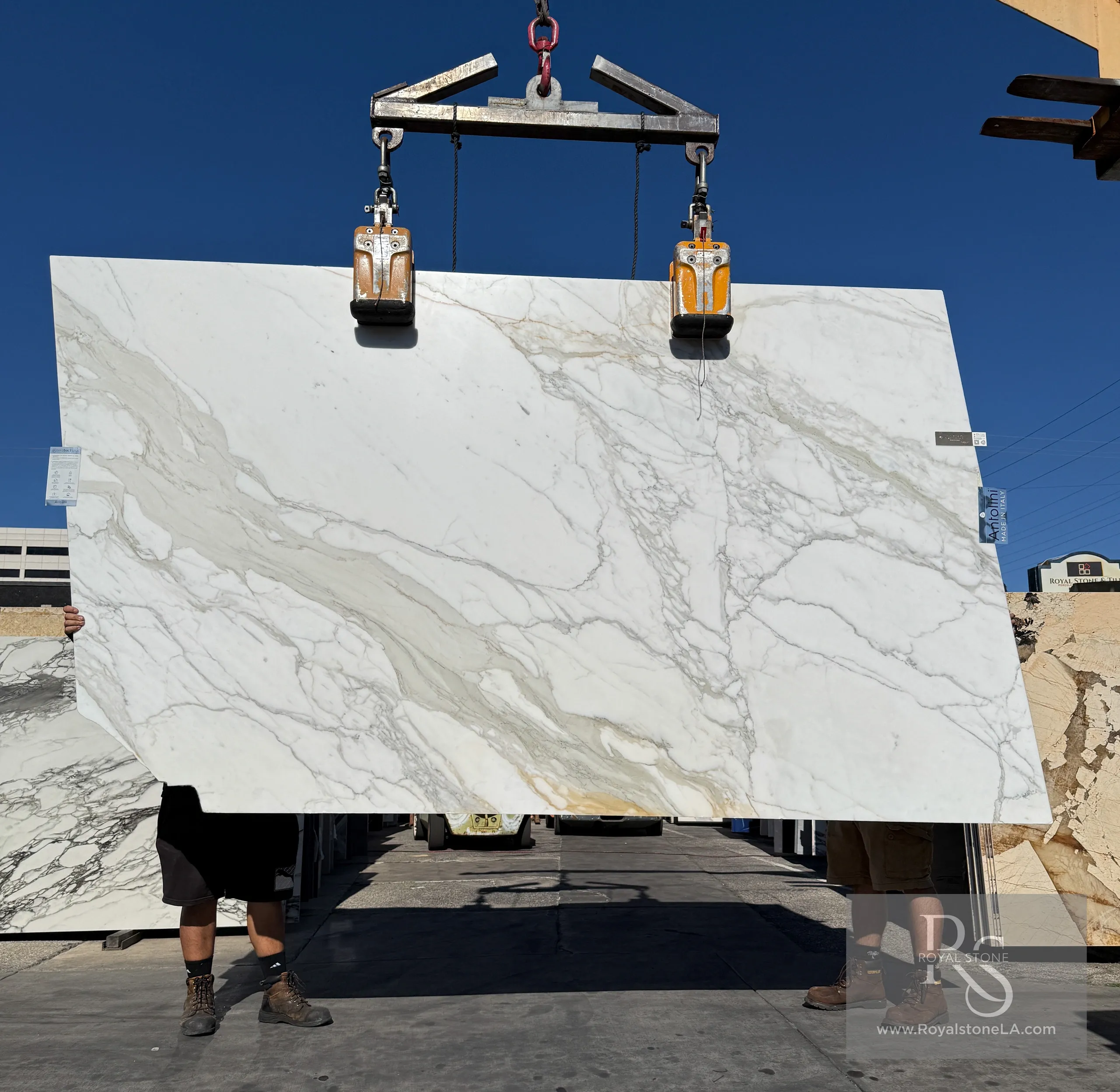
 Borghini
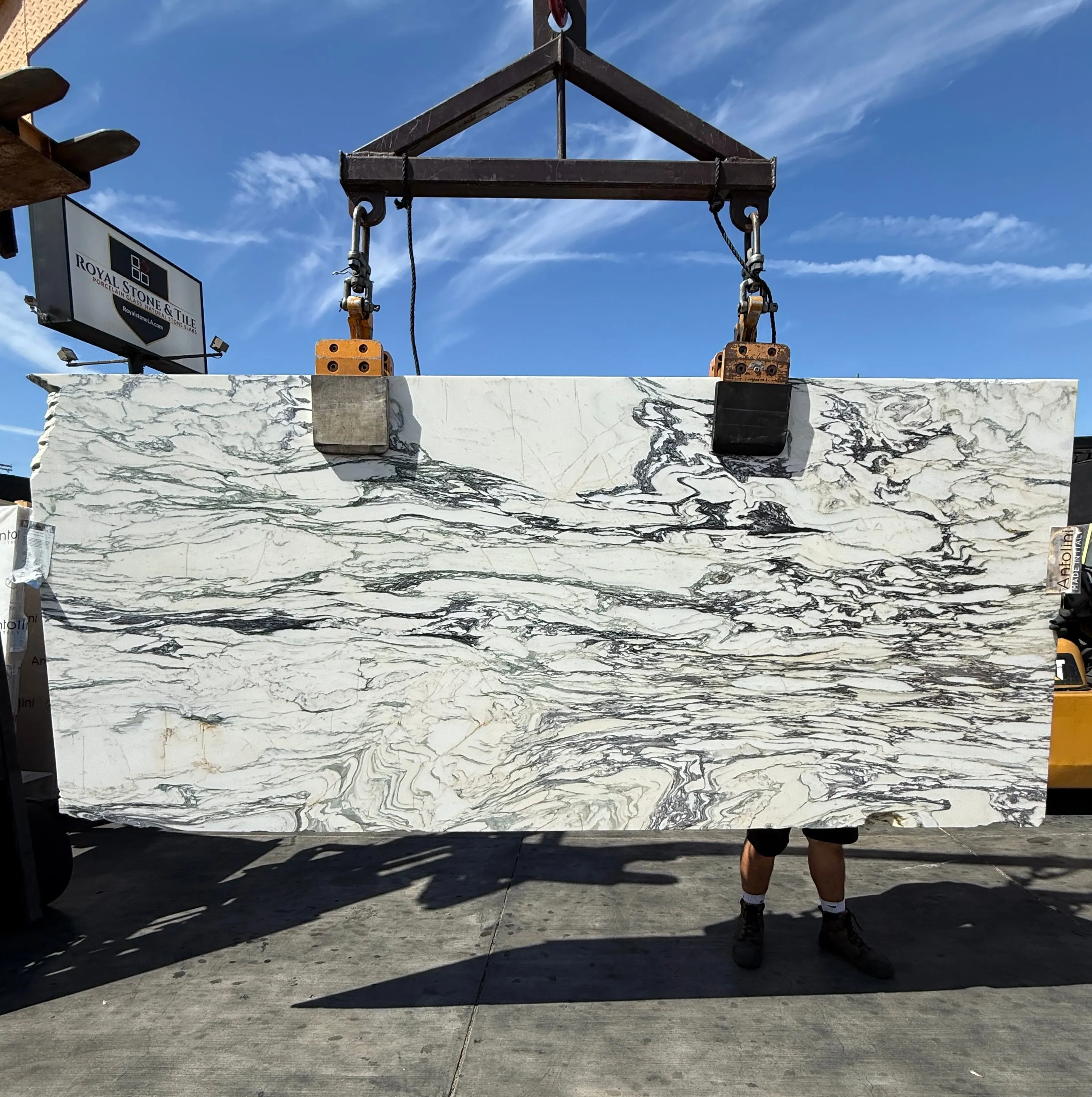 Viola
Viola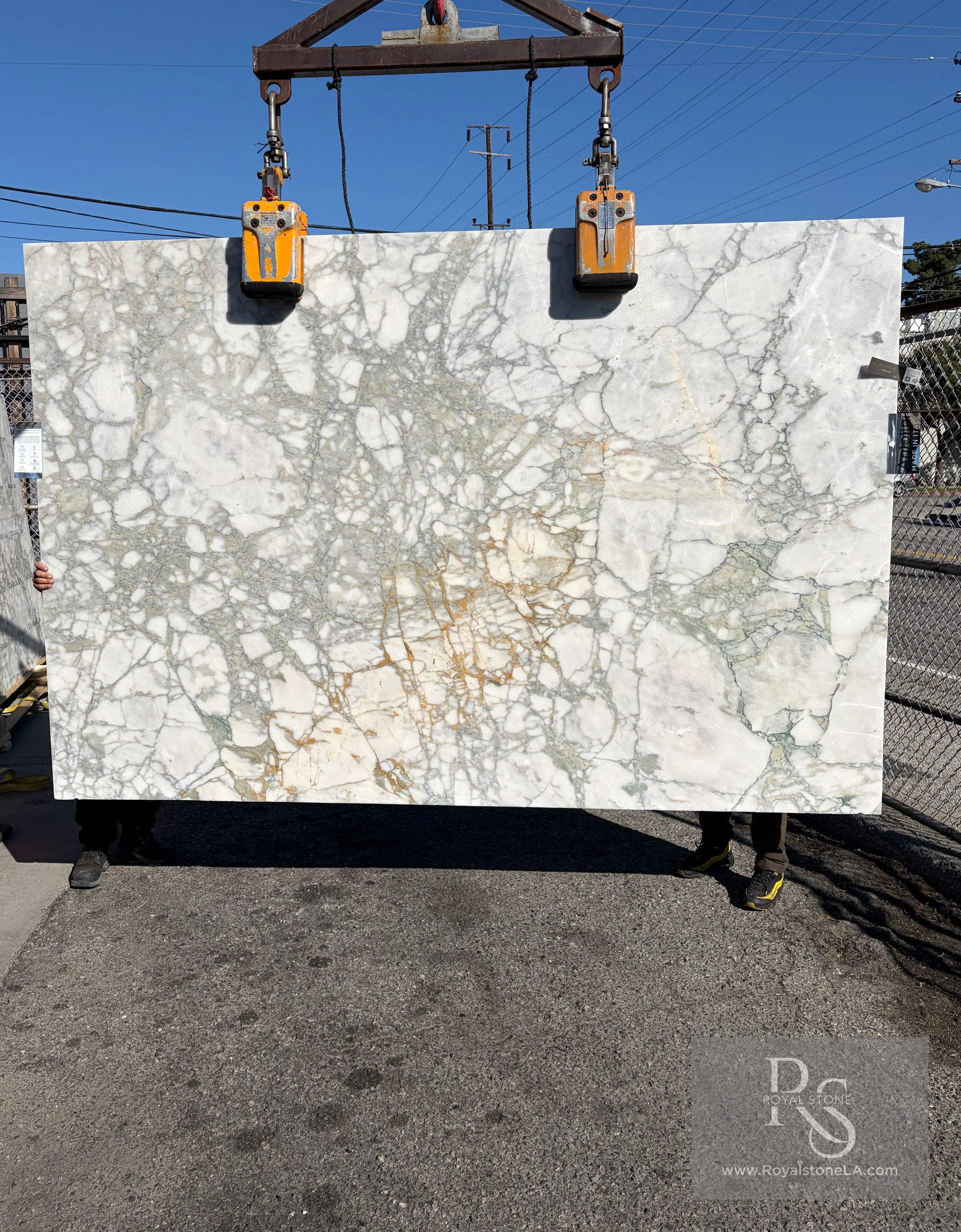 Monet
MonetMarble · Side-by-Side
Calacatta Borghini vs Viola vs Monet.
Three Italian marbles from the same Apuan-Alps geology — the same calcite chemistry, the same Mohs hardness, the same maintenance routine. Three completely different rooms. Borghini is the quiet classical Calacatta. Viola is the architectural event slab. Monet is the painterly middle — coloured but liveable. This is the side-by-side.
A Note on the Comparison
No. 001
The three stones are quarried from the same range, sold in the same tier, and built for different rooms.
All three are Italian Calacatta marbles — calcite-based, pulled from the Apuan-Alps marble basin above Carrara, sold and shipped through the Antolini program in Verona. Mineralogically they are siblings. The difference is in which veins the quarry cut, which mineral inclusions coloured the calcite, and which selectors at Antolini pulled them aside for their own programs.
Borghini is the classical white Calacatta family. Viola is the violet-veined cousin from the same range, named for its saturation. Monet is the painterly selection — lots whose vein behaviour reads as Impressionist wash rather than as line work, and which Antolini publishes under a dedicated program with the named Oro, Verde, Viola and Taupe variants.
Specify them by the room, not by the catalogue. The decision is about what the slab is supposed to do — disappear behind cabinetry, perform as the architectural event, or hold the middle as atmosphere.
02 · At a Glance
Side by side, ten axes.
The straight read across origin, field, vein, personality, hardness, finish, application, bookmatching, slab format and cost. The fuller editorial comparison continues below.
03 · Where They Meet
Similarities.
Geology. All three are Italian marbles from the Apuan-Alps basin above Carrara — the same metamorphic limestone that has produced the Calacatta family since the Roman quarries. Same chemistry, same crystal structure, same age.
Hardness and care. All three sit at Mohs 3–4. All three will etch with lemon, vinegar, wine, tomato. All three want a penetrating marble sealer once a year, neutral pH cleaning, and an honest conversation with the client about what marble does over time.
Curation. All three are pulled at Antolini in Verona for the Royal Stone program. Borghini through the standard Calacatta selection, Viola through the dedicated Viola lots, Monet through the named Monet program (Oro, Verde, Viola, Taupe).
Slab format. All three stock at 2cm gauge with 3cm on selected lots. All three run large enough for single-slab islands or bookmatched bath walls in most floor plans.
Tier. All three are premium Italian marbles. Specified routinely on projects in Los Angeles, Beverly Hills, Bel Air, Pacific Palisades and Malibu. None is “builder marble.”
04 · Where They Diverge
Differences.
Vein language and field colour.
Borghini is line work — distinct, drawn grey-to-gold veins across a cool white ground, the way a classical Italian Calacatta is supposed to read. Viola is colour and brecciation — violet, plum and rust passages running through warm cream, with broken brecciated fragments where the stone has reformed around mineral inclusions. Monet is wash — painterly drifts of green, gold, violet or taupe over a cream-white ground, no two square feet alike, the vein behaviour closer to watercolour than to drawing.
What the room demands.
Borghini wants a refined room — quiet cabinetry, restrained hardware, lighting that lets the vein read without performing. Viola wants the room to hold back — the slab is the architectural event, and any other coloured surface in the room competes with it. Monet sits in the middle: it carries enough atmosphere to register, but stays soft enough to live with day to day. A Monet kitchen reads warm and painted; a Viola kitchen reads dramatic; a Borghini kitchen reads classical.
Finish behaviour.
Polished Borghini pulls the white field up and sharpens the vein. Polished Viola saturates the violet to its loudest reading — often more than the room can carry. Polished Monet shines the surface but can wash out the painterly read; honed is almost always the right call. Honed is the default for all three in our yard. Leathered exists for Viola (it tames the saturation and adds a working hand for kitchens) and is rare for Borghini and Monet.
Bookmatching behaviour.
Borghini bookmatches in a classical sense — linear veins mirror cleanly across a seam, producing the symmetrical composition the term was invented to describe. Viola bookmatches into spectacular two-slab compositions — the violet brecciation reads as a single architectural event across both slabs, and the seam needs to be planned centimetre by centimetre. Monet bookmatches softly — the watercolour washes don’t mirror with crisp symmetry, they produce paired atmospheric compositions, closer to facing pages of a watercolour book than to a mirror.
Scarcity, sequencing and cost.
Borghini moves consistently — the block flow from Carrara is steady, and a designer can specify it from a published lot and trust the next shipment. Viola and Monet are block-by-block selections: which Viola block produced your slab matters, which Monet block produced your Verde matters. Specify both from the slab held, not from a catalogue image. Cost runs Borghini → Monet → Viola in our yard, with rare Monet Verde and Taupe Monet Extra lots crossing into Viola pricing.
05 · Decision Guide
Which one, for what.
A working frame for the specification call.
Specify Borghini when —
- — The brief is “classical Calacatta” — restrained, cool-white, the marble in the background.
- — A kitchen, primary bath, or full-height wall needs to read continuous in a refined room.
- — Cabinetry, hardware, fixtures or art carry the colour; the marble holds the field.
- — Bookmatching for symmetry — the vein needs to mirror cleanly across the seam.
- — Lead time is shorter; Borghini stocks consistently.
Specify Viola when —
- — The slab is the architectural event — feature wall, powder room, hero island, bar front.
- — The room is built to defer to the stone — quiet cabinetry, plain hardware, the saturation does the work.
- — Two-slab bookmatched composition for a feature wall.
- — Leathered finish for a Viola working kitchen — the only sensible way to live with the saturation horizontally.
- — Lead time allows for slab selection — Viola is block-specific.
Specify Monet when —
- — The brief calls for warmth and atmosphere, without Viola’s drama.
- — Dining room, vanity, bath wall, headboard wall, formal entry — surfaces that carry mood rather than perform.
- — The lot itself is the design — Monet Oro for warmth, Monet Verde for the green wash, Taupe Monet for soft brown register, Monet Viola for restrained violet.
- — Honed finish to register the painterly veining correctly.
- — Lead time allows for lot selection — Monet is named lot by lot.
Specify across a project when —
- — A full-house specification needs a quiet kitchen (Borghini), an atmospheric primary bath (Monet), and a hero powder room or bar (Viola). A common pairing in our yard.
06 · Walk All Three
See the slabs in the yard.
All three families are stocked at Royal Stone — 2303 South Sepulveda, Los Angeles, 90,000 sq ft of warehouse, slab yard and showroom combined. By appointment. We will pull Borghini, Viola and a Monet lot, set them side by side under daylight, then move into the showroom to see how each reads under finished fixtures.
Borghini Slabs →
Calacatta Gold Borghini, Top Borghini, Borghini White Vein — the classical Calacatta family in stock.
Calacatta Viola Slabs →
Calacatta Viola Classic, Viola YG580, Viola Brecciato, Viola Rosso Leathered, Viola Rosenoir Paonazzo.
Monet Lots →
Calacatta Monet Oro, Monet Verde, Taupe Monet Extra, Monet Viola — the Antolini Monet program.
Continue
Every Calacatta Type
The full field guide — 15 Calacatta lots organised by family.
Read →The Marble Gallery
Every marble slab in the yard, catalogued.
Read →Antolini Program
The full dealership at Royal Stone — Black Label, Exclusive, Textures+.
Read →Walk the Yard
2303 South Sepulveda, Los Angeles. By appointment. All three families, side by side.
Read →