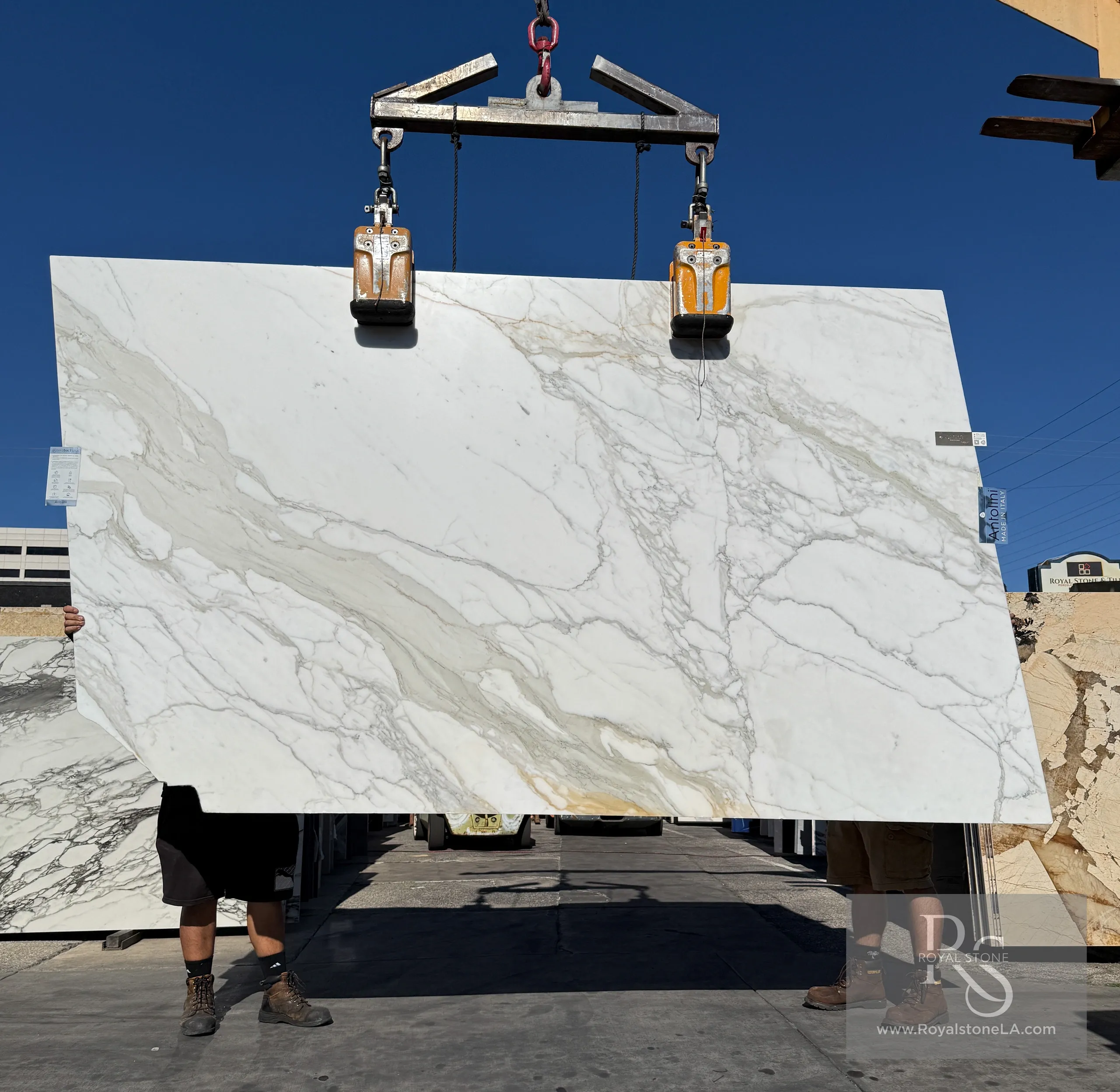
 Calacatta
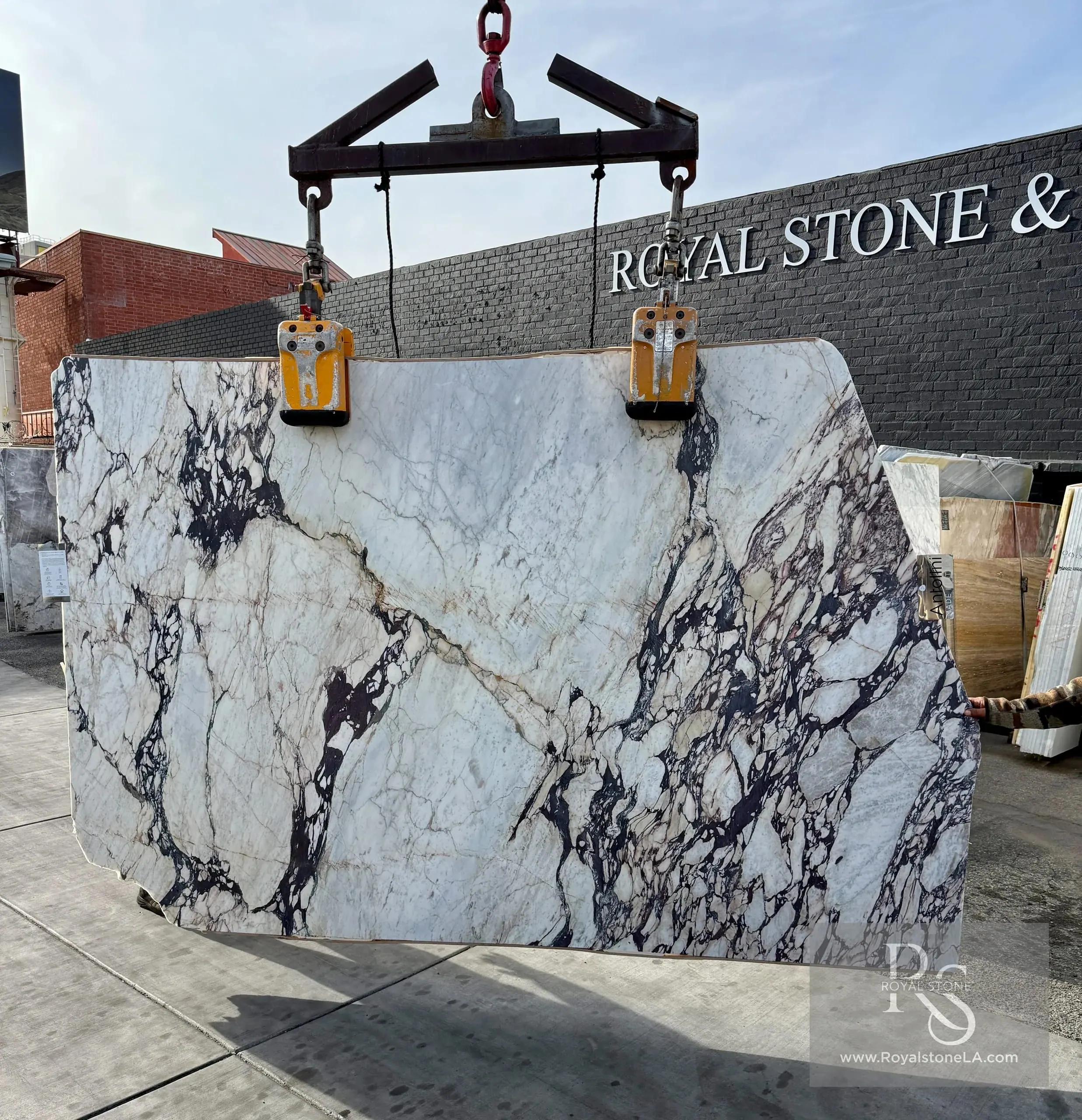 Viola
Viola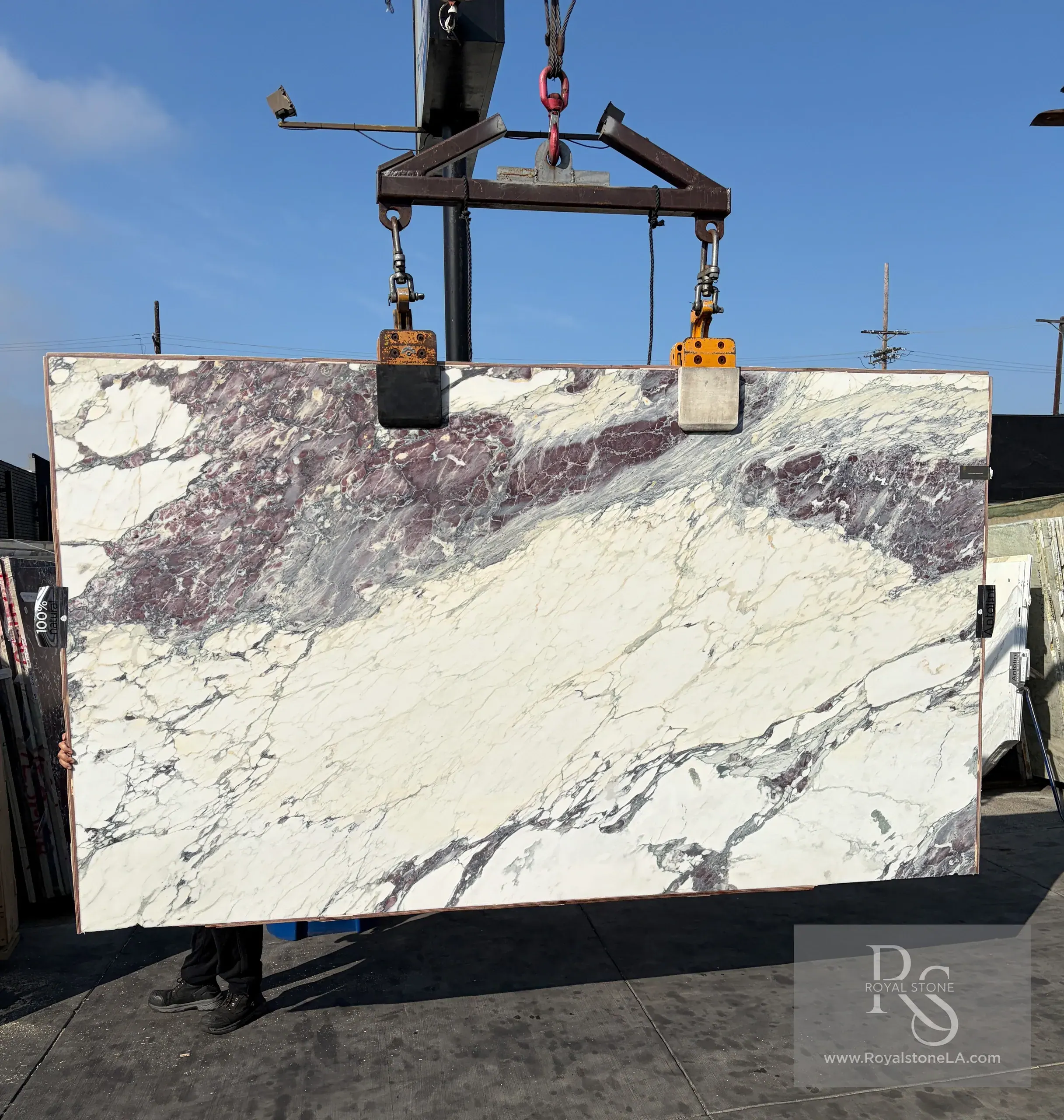 Breccia
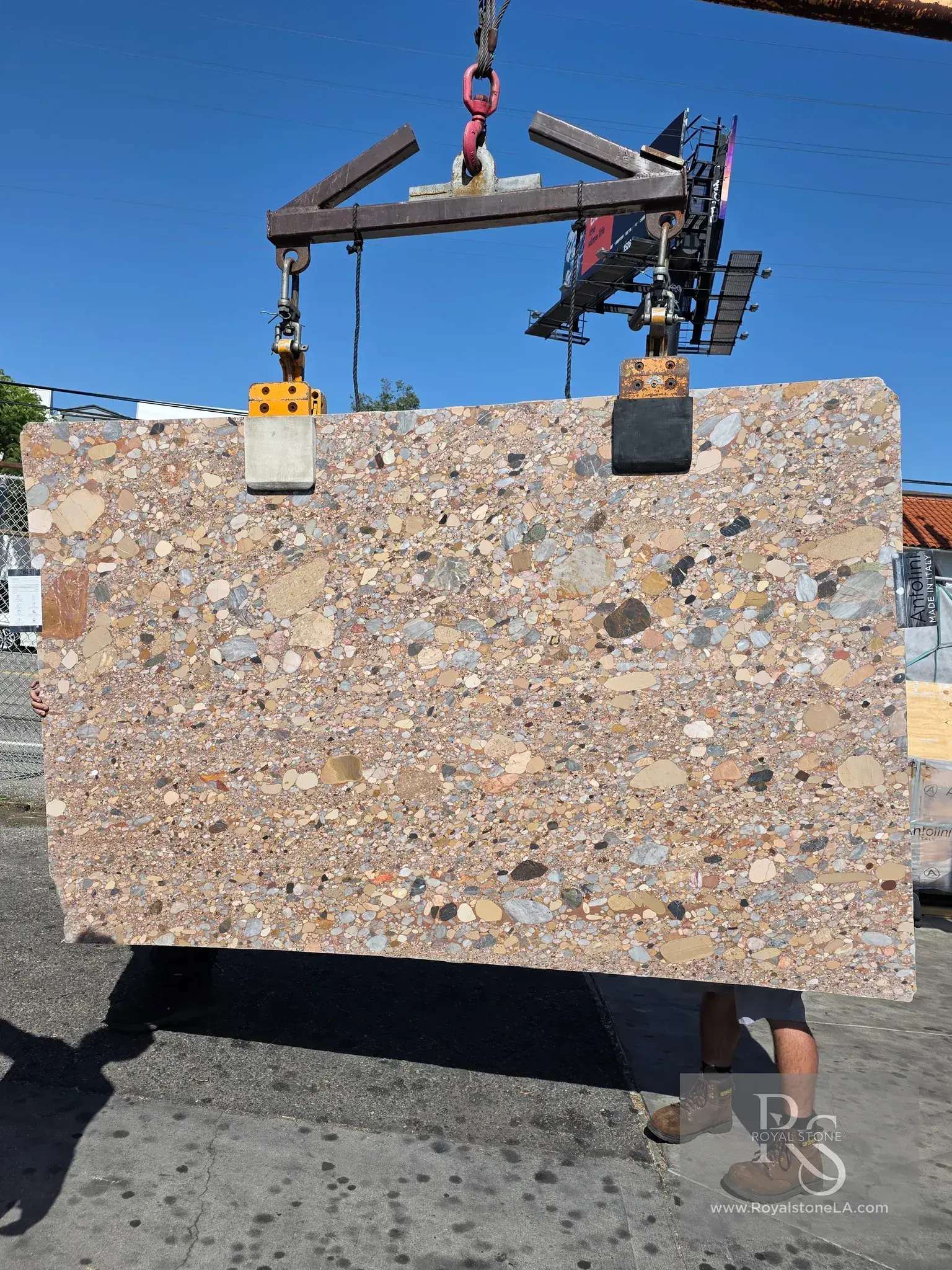 Ceppo
Ceppo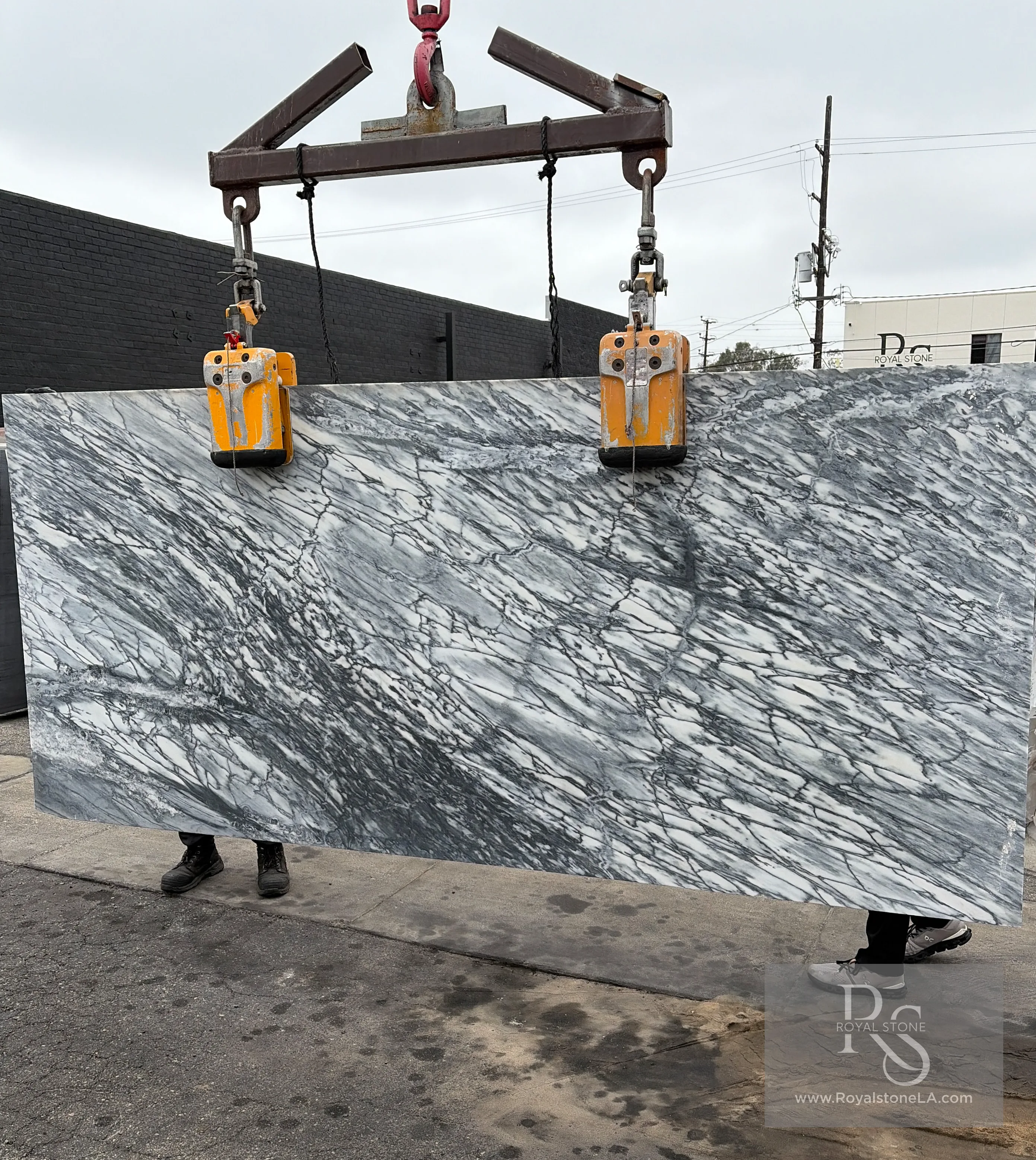 Bardiglio
Italian Marble · A Field Guide
Five Italian marbles, side by side.
Calacatta, Viola, Breccia, Ceppo and Bardiglio — the five Italian marble families in the Royal Stone yard. The first three are cut from the same Apuan-Alps basin above Carrara; Ceppo comes from the ancient riverbed conglomerates of Northern Italy; Bardiglio shares the Carrara chemistry but tips into cool gray. Five marbles. Five completely different rooms.
A Note on Italian Marble
No. 001
Every marble in this page was quarried in Italy — most of it from the Apuan Alps above Carrara.
Calacatta, Viola, Breccia and Bardiglio are four faces of the same Apuan-Alps geology — the metamorphic limestone basin that has produced Italian marble since Roman times. The quarry network runs from Carrara inland into the mountains, with each family pulled from a different band of beds. Ceppo is from a different history entirely — the conglomerate marbles of Lombardy and the pre-Alpine foothills, where ancient riverbeds of rounded pebbles cemented themselves into stone over geological time.
What separates the five is not the country — all of it is Italian — but the cut the quarry made, the inclusions the geology introduced, and the programs the Antolini selectors ran on each block. Specify them by the room, not the name. The decision is about what the slab is doing in the architecture: disappear behind the cabinetry, perform as the architectural event, hold the middle as atmospheric texture, or carry the room in cool gray silence.
Every family below is in stock at the Royal Stone yard in Los Angeles — 2303 South Sepulveda, 50,000 sq. ft. of warehouse, slab yard and showroom combined. Walk the slabs side by side under daylight, then into the showroom under finished fixtures. That's how the comparison is meant to land.
02 · At a Glance
Side by side, ten axes.
The straight read across origin, field, vein, personality, hardness, finish, application, bookmatching, slab format and cost. The fuller editorial comparison continues below.
03 · Where They Meet
Italian pedigree.
Italian quarry. All five families are quarried in Italy — four from the Apuan-Alps basin above Carrara, one from the pre-Alpine foothills of Lombardy. The selection, the cut, and the publication through Antolini in Verona is what gives every Royal Stone slab its Italian pedigree.
Calcite chemistry. Five families, one chemistry — metamorphic limestone recrystallized under pressure into a calcite matrix. Mohs 3–4 across the board. The same acid-etch behavior with lemon, vinegar, wine, tomato. The same annual penetrating-seal routine. The same honest conversation with the client about what Italian marble does over time.
Slab format and care. All five families stock at 2cm gauge with 3cm on selected lots. All five accept honed as the default working finish. All five run large enough for single-slab islands or full-height bath walls in most floor plans.
Antolini selection. All five families pass through the Antolini program in Verona before they reach the Royal Stone yard. Borghini through the standard Calacatta selection. Viola under a dedicated selectors' program. Ceppo, Breccia and Bardiglio across Antolini's natural-stone catalog. Each slab is named and graded at origin.
Los Angeles stock. All five are at the Royal Stone yard — 2303 South Sepulveda — ready to walk in daylight. Specified routinely on projects in Los Angeles, Beverly Hills, Bel Air, Brentwood, Pacific Palisades, Malibu, Santa Monica and Manhattan Beach.
04 · Where They Diverge
Differences.
Vein language versus pattern language.
Calacatta and Viola use a vein language — drawn, structural lines that read as design across the slab. Breccia and Ceppo use a pattern language — distributed geometry (broken fragments in one case, rounded pebbles in the other) that reads as geological composition rather than as line work. Bardiglio sits between them: a thin, irregular vein web across a monochromatic gray ground, closer to a technical drawing than to either a drawn Calacatta or a geological-pattern marble.
What the room demands.
Calacatta wants a refined room — quiet cabinetry, restrained hardware, lighting that lets the vein read without performing. Viola wants the room to hold back — the slab is the architectural event. Breccia asks for a designed setting — the slab is the composition, and the room is its frame. Ceppo reads warmly almost anywhere — characterful but livable, the gentlest of the five. Bardiglio wants a modern, technical room — clean lines, minimal hardware, the cool gray carries the architecture.
Finish behavior.
Honed is the working-kitchen default for the white Calacattas — the matte surface keeps the vein readable under daylight. Viola behaves differently: polished pushes the violet toward true purple (often too much for the room), and leathered is the right finish for a working Viola kitchen. Breccia and Ceppo are honed almost exclusively — polishing flattens the pattern. Bardiglio takes honing naturally and is offered polished for feature applications.
Geography and supply.
Four of the five families come from the Apuan Alps above Carrara — the same metamorphic limestone basin. Ceppo comes from Northern Italy, a different geology entirely. Calacatta and Bardiglio have steady block flow from Carrara; Viola and Breccia are block-by-block selections; Ceppo is sequenced for clast continuity across a project. Specify the saturated lots from the slab held, not from a catalog image.
Cost and tier.
Calacatta is the accessible premium tier — what most Los Angeles kitchens and baths reach for when they want Italian pedigree without top-tier pricing. Bardiglio sits a tier below, the right cool gray when the budget should follow the design. Ceppo is premium-tier, sliding into Viola territory on rare blocks. Breccia Capraia and Breccia Pernice carry similar pricing to high-end Calacattas. Viola is the top tier — Calacatta Viola Classic, Viola YG series and Viola Rosenoir Paonazzo command the highest pricing in the yard.
05 · Decision Guide
Which marble, for what room.
A working frame for the specification call. Five families, five kinds of room.
Specify Calacatta when —
- — The brief is classical Italian marble — restrained, white-to-ivory, the vein in the foreground.
- — A kitchen, primary bath, fireplace surround or full-height wall needs to read continuous in a refined room.
- — Cabinetry, hardware, fixtures or art carry the color — the marble holds the field.
- — Bookmatched symmetry for a bath wall or feature application.
- — Lead time is shorter; Calacatta stocks consistently.
Specify Viola when —
- — The slab is the architectural event — feature wall, powder room, hero island, bar front.
- — The room is built to defer to the stone — quiet cabinetry, plain hardware, the saturation does the work.
- — Two-slab bookmatched composition for a feature wall where the violet brecciation carries the room.
- — Leathered finish for a working Viola kitchen — the only sensible way to live with the saturation horizontally.
- — Lead time allows for slab selection — Viola is block-specific.
Specify Breccia when —
- — The slab is the artwork — fragment composition, matrix, color, a piece of geological architecture in its own right.
- — A feature island, fireplace mass, library wall or formal entry will benefit from the multidirectional pattern.
- — The room can hold a textured, painterly surface — the slab does not disappear, and the design should embrace that.
- — Specify from the slab held — Breccia is block-by-block selection; lot-to-lot variation is significant.
Specify Ceppo when —
- — The brief calls for character without drama — warm, historical, pebbled, livable.
- — A vanity, bath wall, fireplace surround, warm kitchen or full-height feature benefits from the conglomerate surface.
- — The room already carries color and material — Ceppo is the texture, not the color.
- — Ceppo Rosa or Beige Avorio for warmth; Ceppo Nero for dark; Ceppo Quattro Stagioni Libeccio for variable.
- — Long runs work well — the pattern reads continuous across slab-to-slab seam sequencing.
Specify Bardiglio when —
- — The brief is cool and modern — gray monochrome, thin white vein web, technical, engineered feel.
- — A modern kitchen, technical bath, contemporary fireplace surround or hotel-lobby wall is the application.
- — Budget should follow design — Bardiglio delivers pedigree Italian marble without the top-tier Calacatta or Viola pricing.
- — Honed for working surfaces; leathered if etching is a concern with the client.
Specify across a project when —
- — A full-house specification needs a quiet Calacatta kitchen, an atmospheric Breccia or Ceppo feature, a hero Viola powder room, and a cool Bardiglio bath. The five families play well together — common pairings through Royal Stone Los Angeles projects.
06 · Walk All Five
See the slabs in the yard.
All five families are stocked at Royal Stone — 2303 South Sepulveda, Los Angeles, 50,000 sq. ft. of warehouse, slab yard and showroom combined. By appointment. We will pull a slab from each family, set them side by side under daylight, then move into the showroom to see how each reads under finished fixtures.
Calacatta Slabs →
Borghini, Vagli Gold, Monet, Taupe Monet — the classical Italian white family in stock.
Calacatta Viola Slabs →
Viola Classic, Viola Rosenoir Paonazzo, Viola Brecciato, Viola YG580.
Breccia Slabs →
Breccia Capraia Ultimate, Breccia Pernice, Breccia Turquoise Light.
Ceppo Slabs →
Ceppo Rosa di Palladio, Ceppo Beige Avorio, Ceppo Nero, Ceppo Quattro Stagioni Libeccio.
Bardiglio Slabs →
Bardiglio Grey Marble Marmocazi — the cool gray Italian marble.
Continue
Every Calacatta Type
15 Calacatta lots organized by family — Borghini, Gold, Monet, Viola.
Read →Calacatta Borghini vs Viola vs Monet
A focused three-way comparison inside the Calacatta family.
Read →Ceppo Rosa vs Beige vs Nero
Three faces of Italy’s pebbled conglomerate marble.
Read →Walk the Italian Slabs
2303 South Sepulveda, Los Angeles. By appointment. All five families, side by side.
Read →