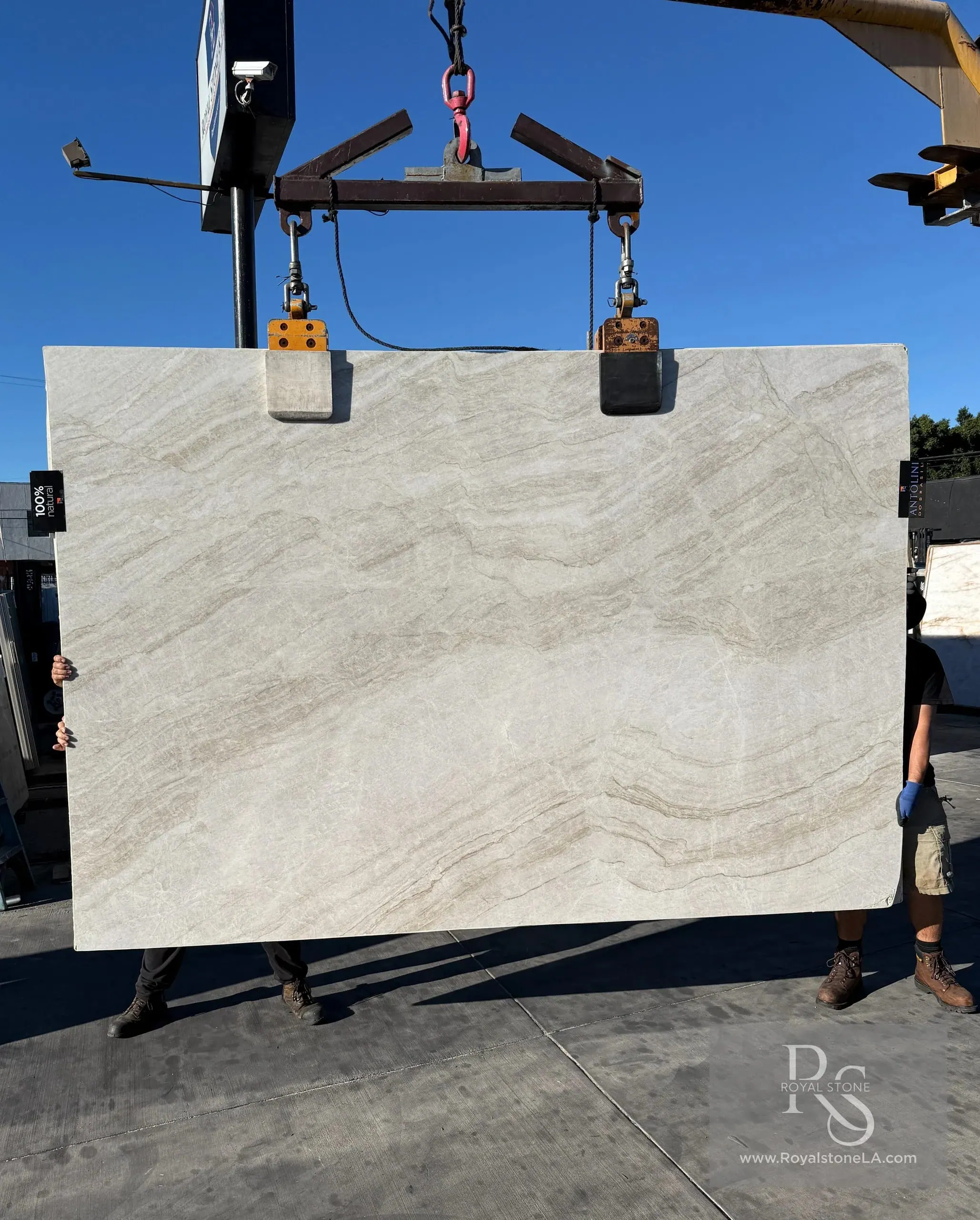
 Taj Mahal
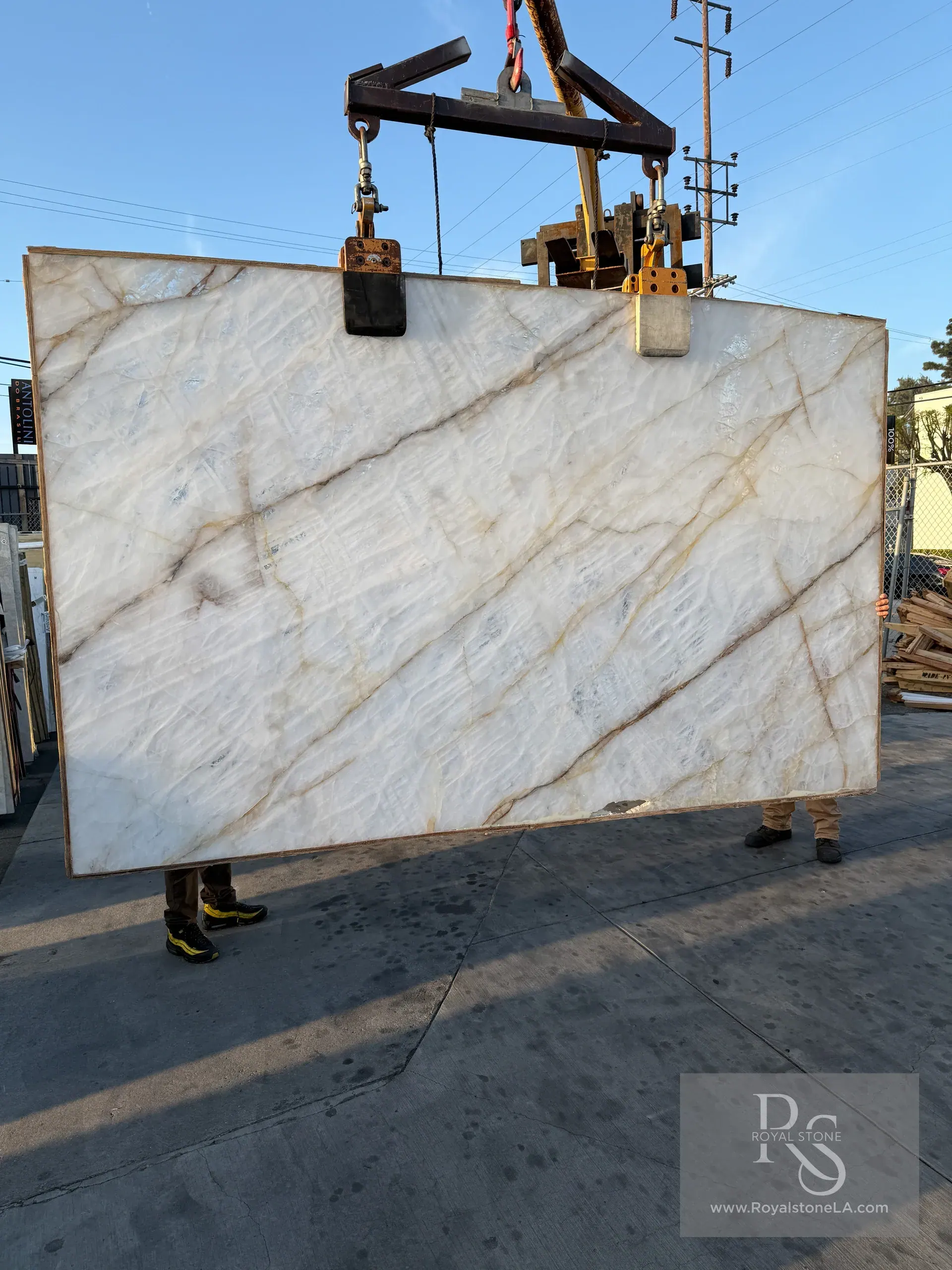 Cristallo
Quartzite · Side-by-Side
Taj Mahal vs Cristallo.
Two of the most-asked-about premium quartzites at the yard. The same family — silica recrystallized under heat and pressure — but two different conversations. Taj Mahal is often specified for working kitchens and reads like Calacatta marble; its performance must be evaluated slab by slab. Cristallo is the translucent stone that turns into an architectural event under backlight. This is the side-by-side.
A Note on the Comparison
No. 001
The two stones are mineralogical cousins. Optically and architecturally, they live in different rooms.
Both stones are sold as quartzite — silica sandstones recrystallized under heat and pressure into an interlocked quartz matrix. Quartzite is generally harder and more scratch-resistant than marble. Performance, porosity and sealing requirements vary by the individual stone, quarry and finish.
Optically they diverge. Taj Mahal is opaque, calm, ivory, and reads as quiet warm marble. Cristallo is translucent, crystalline, and reads as glass with mineral drawn through it. Specify one when the brief is “a working kitchen that looks like Calacatta.” Specify the other when the brief is “a bar top that glows.”
The decision is rarely either-or for a whole house. A working kitchen in Taj Mahal and a backlit powder room or wine bar in Cristallo is a common pairing in projects we ship across Los Angeles, Beverly Hills, Bel Air, Pacific Palisades and Malibu.
02 · At a Glance
Side by side, ten axes.
The straight read across origin, appearance, light, hardness, slab format, finish, application and cost. The fuller editorial comparison continues below.
03 · Where They Meet
Similarities.
Mineralogy. Both are sold as quartzite — quartz sandstones recrystallized under heat and pressure. This is not engineered quartz. Identification and performance should be confirmed for the individual slab.
Hardness. Quartzite is generally harder and more scratch-resistant than marble. The hardness and performance of Taj Mahal and Cristallo vary by the individual stone, quarry and finish.
Origin. Both are Brazilian quartzites. Taj Mahal comes from Espírito Santo state. Cristallo comes from multiple Brazilian quarries curated through Antolini in Verona.
Sealing & care. Porosity and sealing requirements vary by the individual stone, quarry and finish. The specific slab should be evaluated before fabrication, with care selected for that material and application.
Slab format. Both stock at 2cm gauge in the yard. Both are available at 3cm — Taj Mahal more readily, Cristallo by special order. Both are large enough for single-slab islands in most floor plans.
04 · Where They Diverge
Differences.
Translucency is the headline.
Taj Mahal is opaque. It reads the same lit from the front, whether or not anything is behind it. Cristallo is translucent — light passes through the crystalline silica passages. Backlit, the veining reads as drawing on glass and the field carries a warm or cool glow depending on the lot. Specified for a backlit application, Cristallo is the only natural stone that gives you that result. Specified for an opaque countertop, both stones perform — but Cristallo costs more without delivering the property you paid for.
Field color and personality.
Taj Mahal lives in the warm-ivory-to-pale-gold range. Quiet. Continuous. Designed to disappear behind cabinetry and hardware. Cristallo, depending on the lot, runs the full spectrum of the program — White (cleanest), Brut Champagne (warm), Rosa (pink blush), Cobalt Zaffiro (saturated blue), Trasviolet (violet), Tiffany Jade and Emerald (greens), Vitrum Dual (two-tone single slab). One stone is a steady background; the other is a catalog of architectural events.
Vein language.
Taj Mahal’s veining is soft, drawn, low-contrast — the way a quiet Calacatta or a Bianco Lasa reads. Cristallo’s veining is crystalline and structural — passages where the silica has recrystallized more completely, registering as glass-clear channels through the field. Two different geological stories on the slab face.
Scarcity and lead time.
Taj Mahal is consistently in the yard. The block flow from Espírito Santo is steady and the lots are predictable enough that a designer can specify it from a photograph and trust the next shipment. Cristallo is lot-specific, especially in its saturated-color cuts. Cobalt Zaffiro, Trasviolet, Tiffany Jade — those are blocks that come and go, and the slab you select needs to be the slab that ships. Specify Cristallo with the slab held, not from a catalog image.
Cost.
Taj Mahal sits in the premium quartzite tier but is accessible at scale — the most-specified stone in our yard for working white kitchens. Cristallo is a tier above for the standard lots and two tiers above for the saturated colors. The premium pays for the translucency, the Antolini curation, and the block-by-block selection.
05 · Decision Guide
Which one, for what.
A working frame for the specification call.
Specify Taj Mahal when —
- — The brief is “Calacatta look in a real-life working kitchen.”
- — Full slab runs are needed across a kitchen, an island, a backsplash, and a bath in one continuous lot read.
- — Budget is premium-quartzite tier but not Antolini-tier.
- — The surface is horizontal, taking hand contact, and needs to read calm rather than spectacular.
- — Lead time is short — Taj Mahal is consistently in stock.
- — Outdoor leathered for a kitchen, bar, or pool deck.
Specify Cristallo when —
- — The installation is backlit — bar top, vanity top, pendant fixture, gallery wall, hospitality entry.
- — The brief calls for a saturated color from natural stone — Cobalt, Trasviolet, Tiffany Jade, Emerald, Rosa.
- — The slab is the architectural event of the room, not the quiet field behind it.
- — Project schedule allows time to walk the yard and hold a specific slab — Cristallo is lot-specific.
- — Budget supports premium-Antolini tier, especially for the saturated colors.
Specify both when —
- — A full-house specification calls for a working kitchen and a hero bar, vanity or powder room. Taj Mahal in the kitchen, Cristallo in the backlit room.
- — A hospitality fit-out needs back-of-house workhorse counters and a front-of-house feature wall under light.
06 · Walk Both
See the slabs in the yard.
Both stones are stocked at the Royal Stone yard in Los Angeles — 2303 South Sepulveda, 50,000 sq. ft. of warehouse, slab yard and showroom combined. By appointment. We will pull a Taj Mahal slab and a Cristallo slab and set them under daylight and fixtures, then move the Cristallo to the backlight panel so you read both states.
Continue
Cristallo Field Guide
Every type — White, Brut Champagne, Trasviolet, Cobalt, Tiffany Jade, Vitrum Dual.
Read →Fusion Quartzite Guide
Blue Fusion, Paolo di Caravaggio, Green Fusion — the moving-vein family.
Read →Antolini Program
The full dealership at Royal Stone — Black Label, Exclusive, Textures+.
Read →Walk the Yard
2303 South Sepulveda, Los Angeles. By appointment. Both stones, both lighting states.
Read →